

The Imperial Palace, also known as the Forbidden City or "Gugong", was the imperial residence and center of the kingdom during the reign of 24 emperors. 14 in the Ming and 10 in the Qing dynasty resided and ruled from this palace for 491 years until Puyi, the last emperor of the Qing dynasty and of China. It is now the largest and best preserved ancient architecture in China.
Located in the center of Beijing, the Imperial Palace covers an area of 72 hectares. Rectangular in shape, it runs 960 meter long from north to south. And 750 meter wide extended from east to west. There is a 10-meter high wall, encircled by a 52-meter wide moat.
The palace boasts more than nine thousand rooms, with layout following strict feudal code. The palace is divided into two main sections:- the Front Palace and the Inner palace. In the center of the Front Palace stand the Hall of Supreme Harmony, the Hall of Complete Harmony and the Hall of Preserving Harmony. The Inner Palace includes the Palace of Heavenly Purity, the Hall of Prosperity, the Hall of Earthly Peace and the Imperial Garden.
There are four gates at each corners of the walls:- The Meridian Gate to the south, the Gate of Divine Military Genius to the north, the East Flowery Gate to the east and the West Flowery Gate to the west. The Gate of Divine Military Genius was the gate connecting the imperial palace with the market area to the north of the palace. It is the largest gate of the Forbidden City, 35.6 meters high and surmounted by five pavilions. The central pavilion is rectangular in shape, while the other four, two on each side are square and hence the nickname is "The Five Phoenix Tower"
The Meridian Gate was so named because the Chinese emperors believed that they lived in the center of the universe, and the Meridian Line went through the Forbidden City.
A pair of bronze lions guards the Gate of Supreme Harmony, symbolizing the imperial power. In China, lions were supposed to be good doorkeepers and put at the gate to ward off evil spirits. Lions are frequently seen in front of buildings as guardians, one playing with a ball (male) and the other a cub (female). It was considered auspicious. The ball is said to represent imperial treasury or peace. The cub sucks milk from underneath the claw, because the female doesn't have breast.
The hall of Supreme Harmony is 35 meter high, 60 meter wide and 33 meter on both sides. It is now the largest, best preserved wooden hall in China. Twenty-four pillars support the roof. The Central six are gilded and painted red. The Emperor throne, which is surrounded by art treasures of symbolic significance, is in the middle of the hall.
Above the throne is gold painted caisson, or coffer ceiling, with dragon designs, from which hangs a spherical pearl called The Xu Anyuan mirror?
Three flights of marble steps leads up to the terrace In the middle of the central flight is a huge carving in the design of Dragons playing with pearls over which the emperors sedan chairs were carried. At the east corner of the terrace is a sundial, and at the west corner stands a small temple in which the grain measure was kept. The sundial and grain measure is both symbols of rectitude and fairness.
Behind the Hall of Preserving Harmony, between the stairways, is a huge one-piece marble carving of Dragons playing with pearls? This marble was brought here all the way from Fang Shan District, about 70 km away from Beijing City proper. It is about 17 meters long, 3 meters wide and 1.7 meters thick, weighing about 250 tons. Without any modern means of transportation, you can imagine how difficult it was for the Chinese laborer to transport such a huge piece of stone here!
Facing the Gate of Imperial Supremacy in the Hall of Jewelry is the famous Nine Dragon Screen, the best of its kind and the biggest in China. The main body of the screen was engraved with nine huge dragons. Each dragon is playing with a jewelry ball, each with different unique appearance. The dragons were painted with different colors with three dimension visual appearance and were handcrafted with highest skill of workmanship. It is truly the most beautiful piece of art.
The Imperial Palace is the largest museum in China; it preserves more than 900,000 priceless antiques covering all dynasties of Chinese history. It has been recognized as the biggest and most important treasury house of Chinese culture and arts in the world.


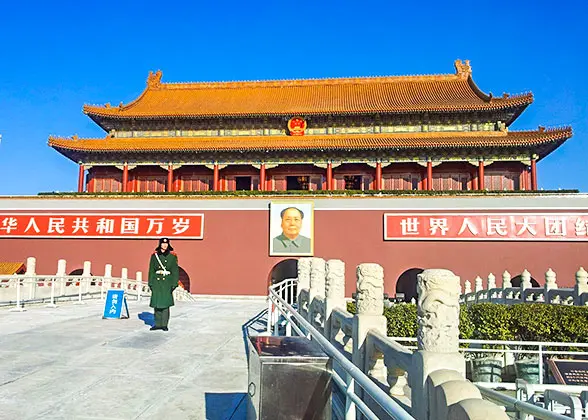 How can one city boast so many phenomenal places? Beijing's long and illustrious history started some 500,000 years ago. It is here that the ancestors of modern Homo sapiens, Peking men, lived in caves. Records show that Beijing has been an inhabited city for more than three thousand years and has endured invasions by warlords and foreign powers, devastating fires, the rise and fall of powerful imperial dynasties and has emerged each time as a strong and vibrant city. For more than 800 years, Beijing was a capital city - from the Yuan Dynasty (1271 - 1368) to the Ming (1368 - 1644) and Qing (1644 - 1911) dynasties. Thirty-four emperors have lived and ruled the nation in Beijing and it has been an important trading city from its earliest days.
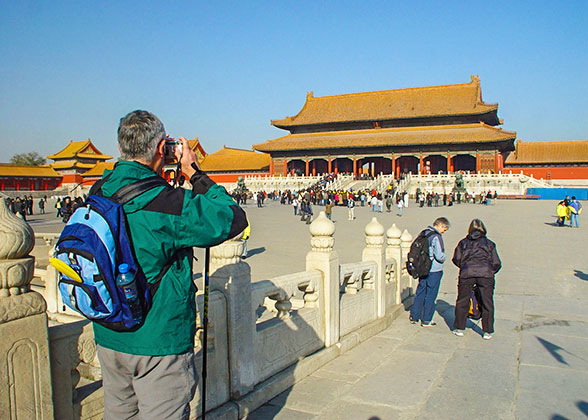 After a day's Beijing tours, nighttime can hold other surprises for you. These can vary from traditional performances such as the Beijing Opera, acrobatics and martial arts to modern ones including concerts, ballroom dancing, pubs and clubs. Each and every one has its individual enchantment for the tourist. No description of our capital city is complete without mention of the friendly people who throng the streets. Everywhere you will encounter smiling faces and a warm welcome, especially from the children who love to say 'Hello!' All these things add up to truly make your visit a cultural experience of a lifetime.
 Posts
Posts


